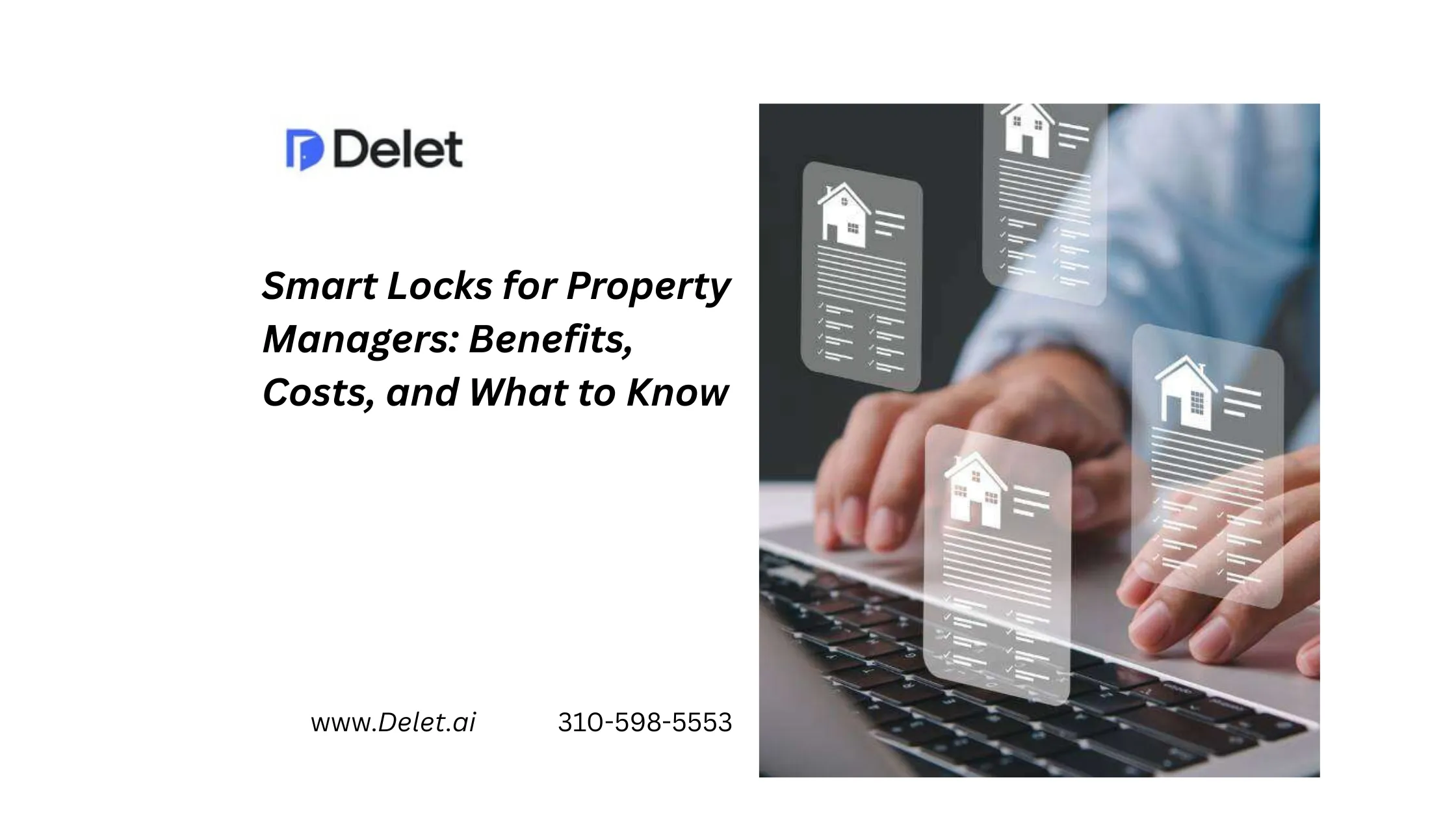
Smart Locks for Property Managers: Benefits, Costs, and What to Know
For property managers, a smart lock is more than a replacement for a traditional key. In a U.S. rental property, the right smart access system can help teams control entry remotely, simplify move-ins and maintenance access, support apartment self tours, and reduce repetitive key-management work.
That matters even more for California property managers and multifamily operators managing multiple properties. When dozens or hundreds of units are involved, small access problems—lost keys, lockouts, rekeying, or staff traveling to provide entry—can become recurring operational costs.
The key question isn’t simply whether a smart lock is convenient. It’s whether the technology can make property access more secure, measurable, and easier to manage at scale.
What Are Smart Locks for Property Managers?
Smart locks are electronic locking systems that use digital credentials such as PINs, mobile devices, cards, or other authorized methods instead of relying solely on physical keys.
For smart locks property managers, the important feature is controlled access.
Depending on the system, managers may be able to:
- Grant or revoke access remotely
- Create temporary credentials
- Manage staff and vendor access
- Track access activity
- Support self-guided apartment tours
- Reduce physical key handoffs
- Connect access with property-management software
Multifamily access providers increasingly position smart locks as part of centralized access management rather than standalone hardware.
Property-management insight: The lock is only one component. The software controlling credentials, users, schedules, integrations, and access history can determine much of the system’s real operational value.
Why Property Managers Are Moving Beyond Traditional Keys
Traditional keys create several recurring problems.
A key can be lost, copied, left inside a unit, or given to the wrong person. When a tenant moves out, the property team may also need to collect keys or rekey the unit.
Smart access changes the process from “Who has the key?” to “Who is authorized to access the property right now?”
That distinction becomes particularly useful when managing:
- Vacant apartments
- Maintenance appointments
- Vendor visits
- Unit turns
- Move-ins and move-outs
- Self-guided tours
- Multiple communities
Rently, for example, highlights smart locks for keyless entry, remote access control, and activity monitoring, while Everon promotes remote credential management and time-limited access for vendors and maintenance teams.
7 Benefits of Smart Locks for Property Managers
1. Remote Access Control
Property managers don’t always need to be physically present to manage access.
Digital credentials can allow authorized users to enter during approved periods. Access can then be modified or revoked when circumstances change.
For a manager overseeing properties across California or other U.S. markets, this can reduce unnecessary trips to individual units.
2. Easier Apartment Self Tours
Smart locks are a critical component of many apartment self-tour systems.
A prospect can schedule a tour, complete required verification, receive authorized access, and enter the apartment without a leasing agent physically handing over a key.
Tour24 and Rently both integrate access technology into self-guided touring workflows.
Delet takes a broader approach by combining smart-lock access with apartment self-showing, visitor identity verification, live HD camera monitoring, and centralized management.
3. Less Key Management
Physical keys create administrative work.
Smart locks can reduce the need to:
- Store large key collections
- Track individual key holders
- Arrange repeated key handoffs
- Replace lost keys
- Coordinate physical access for every visit
That doesn’t automatically eliminate every access-related cost, but it can remove repetitive tasks from the leasing and operations workflow.
4. Better Control During Unit Turns
Unit turnover often requires several people to access the property.
Maintenance workers, cleaners, inspectors, contractors, leasing employees, and prospective renters may all need entry.
Instead of distributing physical keys, managers can create appropriate digital credentials and change them as the unit moves through its turnover process.
5. Support for After-Hours Leasing
A vacant apartment doesn’t stop being available simply because the leasing office closes.
Smart access can support approved evening or weekend touring windows, allowing property managers to make apartments accessible when their teams aren’t physically onsite.
The U.S. Census Bureau reported a 7.3% national rental vacancy rate in Q2 2026, underscoring the continuing importance of available rental inventory in the U.S. housing market.
Smart locks don’t reduce vacancy by themselves. Their value comes from removing access friction when they’re integrated into a well-designed leasing process.
6. Access Records Improve Visibility
Digital access can create an audit trail showing when credentials were used.
That can help property teams understand:
- Who accessed a unit
- When access occurred
- Which credential was used
- Whether access happened during an approved window
- Where operational issues occurred
This visibility becomes even more valuable when paired with real-time tour monitoring.
7. Easier Portfolio Management
A property manager with one rental has different requirements from a company managing hundreds of units.
A centralized property dashboard can make it easier to manage access across multiple locations rather than treating every lock as a separate device.
This is one reason multifamily access providers emphasize portfolio-level management and PMS integrations.
How Smart Locks Work With Apartment Self Tour Technology
A strong apartment self-tour workflow can look like this:
Lead → Tour Booking → Visitor Identity Verification → Temporary Access → Self Tour → Monitoring → Follow-Up
Smart locks handle the access portion.
The broader platform can manage the rest.
That’s an important distinction when comparing solutions.
A smart lock by itself may let someone unlock a door remotely. An apartment self-tour platform can connect the lock to prospect scheduling, identity verification, tour instructions, monitoring, and leasing activity.
Delet’s platform is designed around this combined model, including smart locks, visitor verification, live monitoring, remote access control, and centralized tour management.
How Much Do Smart Locks Cost for Property Managers?
There isn’t one standard smart-lock price for rental properties.
Total cost can include:
| Cost Area | What Property Managers Should Check |
| Hardware | Lock, hub, gateway, or related devices |
| Software | Monthly or annual platform fee |
| Installation | Self-installation vs professional installation |
| Connectivity | Wi-Fi, Bluetooth, Z-Wave, cellular, or hub requirements |
| Integration | PMS, CRM, leasing, or smart-home integrations |
| Maintenance | Batteries, replacements, service |
| Access devices | Additional locks or credentials |
| Monitoring | Camera or security monitoring costs |
| Support | Technical or prospect support |
For example, ShowMojo currently offers property-management plans that can coordinate self-guided tours with smart locks or lockboxes, while Rently offers smart-access products alongside its touring platform.
Don’t compare hardware price alone. Compare the complete cost of ownership.
How Smart Locks Can Reduce Vacancy Costs and Workload
A vacant apartment continues to represent lost rental income until it is leased.
Suppose a $2,400/month apartment remains vacant for another 10 days.
The gross rent associated with those 10 days is approximately:
$2,400 ÷ 30 × 10 = $800
That doesn’t mean smart locks will recover $800. It illustrates why property managers should measure the financial impact of delays.
Delet’s apartment vacancy calculator can help property teams examine empty vacancy cost and consider how self-guided tours can potentially reduce access-related workload and leasing delays.
The more useful ROI calculation is:
Vacancy Cost + Staff Time + Travel + Key Management + Access Administration
versus
Technology Cost + Hardware + Installation + Support
This produces a much more realistic picture than comparing monthly lock prices.
Smart Locks and Visitor Identity Verification
Smart access becomes more powerful when combined with visitor identity verification.
This matters because self-guided access should not mean unrestricted access.
The FTC reported nearly 65,000 rental scam reports and about $65 million in reported losses between January 2020 and June 2025. The FTC also notes that scammers have sometimes copied legitimate rental listings and used self-guided tour mechanisms to make fake listings appear legitimate.
For property managers, that reinforces an important principle:
Convenient access needs trustworthy verification and clear controls.
Identity verification, time-limited credentials, access logs, and monitoring can work together as part of a more controlled self-tour process.
What Smart Lock Technology Should Property Managers Look For?
Before buying, ask these questions:
Does it work with your doors?
Not every lock fits every door.
Check hardware compatibility before selecting a platform.
Does it require Wi-Fi?
Some systems rely on Wi-Fi, while others use Bluetooth, Z-Wave, cellular connectivity, or a hub.
Rently, for example, discusses Z-Wave, Bluetooth, and Wi-Fi as common smart-lock communication approaches.
Can access expire automatically?
Time-limited credentials are especially important for self-guided tours and temporary vendor access.
Can access be revoked remotely?
This is useful when a tour is canceled or circumstances change.
Is there an access history?
Managers should be able to review relevant access activity.
Can it integrate with your existing software?
Portfolio operators should check PMS, CRM, leasing, and smart-home integrations.
Can you manage multiple properties centrally?
A solution that works for one apartment may become cumbersome across dozens of communities.
Related blog: TDI Properties Success Story: How Apartment Self Tours Reduced Vacancy Days by 40%
Smart Lock + Camera Monitoring: Why the Combination Matters
A smart lock tells you about access.
A camera can provide visibility into activity.
Combining smart access with live HD camera monitoring can provide property teams with a broader view of what is happening during a self-guided tour.
Delet specifically combines smart-lock access with live camera streams, remote lock controls, and centralized management.
This is particularly relevant for vacant units where no leasing employee is physically present.
Common Smart Lock Mistakes Property Managers Should Avoid
Choosing the cheapest lock: Lower hardware cost can become expensive if the system lacks integrations or requires substantial manual work.
Ignoring connectivity: A system that doesn’t fit the property’s connectivity environment can create operational problems.
Treating the lock as the whole solution: Access is only one part of leasing automation.
Skipping identity verification: Self-tour convenience should be balanced with appropriate access controls.
Forgetting portfolio scalability: Evaluate how the system will work when the number of properties doubles.
Not measuring ROI: Track staff time, access requests, tours, vacancy days, and operational costs before and after implementation.
Delet’s Approach to Smart Locks for Property Managers
Delet is positioned as an all-in-one smart-access and apartment leasing platform for U.S. property managers and multifamily housing teams.
Its current platform combines:
- Smart locks
- Apartment self-showing
- Visitor identity verification
- Remote access control
- Live HD camera monitoring
- Centralized property dashboards
- Automated leasing workflows
Delet currently reports 8.5K properties leased, 14 average rental days, and 20K prospects toured on its website. These are Delet-reported platform figures rather than independent industry benchmarks.
Its current published Smart Start pricing begins at $150 per kit per month plus a $400 upfront cost, while other plans have different commitment structures. Pricing and included features should be confirmed directly with Delet before purchase.
For property managers evaluating the complete solution, Delet;s Apartment sef tour software features and property-managagers solutions provide additional information on its access and leasing technology.
Final Thoughts
Smart Locks for Property Managers should be evaluated as part of an operating strategy—not simply as a hardware upgrade.
For U.S. and California property managers, the strongest solution can connect smart access, apartment self tours, visitor identity verification, real-time tour monitoring, centralized property dashboards, and leasing workflows.
The real value comes from what happens around the lock.
If the technology helps a leasing team provide controlled access, reduce unnecessary staff coordination, support self-guided tours, and manage multiple properties more efficiently, it can become a meaningful part of a modern property-management operation.
And when evaluating the investment, don’t ask only, “How much does the smart lock cost?”
Ask:
“How much time, access friction, and vacancy-related cost can the entire system help us manage?”
FAQs
Are smart locks worth it for property managers?
They can be, particularly for managers handling multiple properties, frequent unit turnover, maintenance access, or self-guided tours. The business case depends on hardware, software, labor savings, vacancy costs, and portfolio size.
Can smart locks help reduce apartment vacancy?
Smart locks don’t directly guarantee faster leasing. They can reduce access friction and support apartment self tours, including approved after-hours availability. The overall impact depends on the complete leasing process.
Can smart locks be used for apartment self tours?
Yes. Smart locks are commonly integrated into self-guided touring systems. They can provide temporary, controlled access to verified prospects during scheduled tours.
Are smart locks secure for rental properties?
Security depends on implementation. Property managers should look for appropriate authentication, temporary credentials, remote access controls, access logs, encryption, and other security measures.
What is smart lock integration?
Smart lock integration connects the lock to another software platform, such as a property-management, leasing, self-tour, or smart-home system. This can allow access to be managed as part of a broader workflow.
Do smart locks work without Wi-Fi?
Some do and some don’t. Technologies vary by product, including Bluetooth, Z-Wave, Wi-Fi, cellular connections, and hub-based configurations. Property managers should confirm connectivity requirements before installation.
Can smart locks help reduce leasing staff workload?
They can reduce certain repetitive access tasks, including physical key handoffs and some in-person access requirements. When combined with apartment self-tour software, they can also reduce manual tour coordination.
What should property managers compare before buying smart locks?
Compare hardware compatibility, connectivity, access methods, temporary credentials, remote management, access history, integrations, installation, support, scalability, and total cost of ownership.
September 21, 2026