The Hidden Risks of Unmonitored Self-Guided Apartment Tours
Self-Guided Apartment Tours Are Convenient—but Security Matters
Self-guided apartment tours give renters the flexibility to tour available units without waiting for a leasing agent. For property managers, they can also reduce repetitive scheduling and showing work.
But convenience creates a question that should not be ignored:
Who is entering the property, when are they entering, and what happens if something goes wrong?
A secure apartment self-tour should connect visitor identity verification, smart access technology, time-limited credentials, and real-time tour monitoring. Without those layers, a self-tour program can create security, fraud, privacy, and operational risks.
The U.S. rental market also makes efficient leasing important. The Census Bureau reported a 7.3% national rental vacancy rate in Q2 2026.
The goal isn’t to avoid self-guided tours. It is to implement them correctly.
What Are the Hidden Risks of Self-Guided Apartment Tours?
1. Unauthorized Property Access
A basic lockbox or reusable access code can create unnecessary exposure.
If credentials are shared, reused, or remain active longer than necessary, property managers may lose visibility into who actually entered the unit.
A stronger approach uses:
- Identity verification before access
- Unique credentials
- Time-limited access
- Automatic credential expiration
- Access logs
Rently, for example, describes ID verification and a full audit trail showing who accessed a property, when, and for how long.
2. Identity and Rental Fraud
Self-tour technology can create a difficult security paradox: the same convenience that helps legitimate renters can be exploited by scammers.
The FTC specifically warns that rental scammers have copied legitimate listings and used self-guided tours to make fraudulent properties appear legitimate.
That makes visitor identity verification more than a convenience feature.
Property managers should verify the person receiving access and maintain records of the access event.
3. No Visibility During the Tour
Access logs tell you who entered.
They don’t necessarily tell you what happened inside.
This is where real-time tour monitoring becomes valuable.
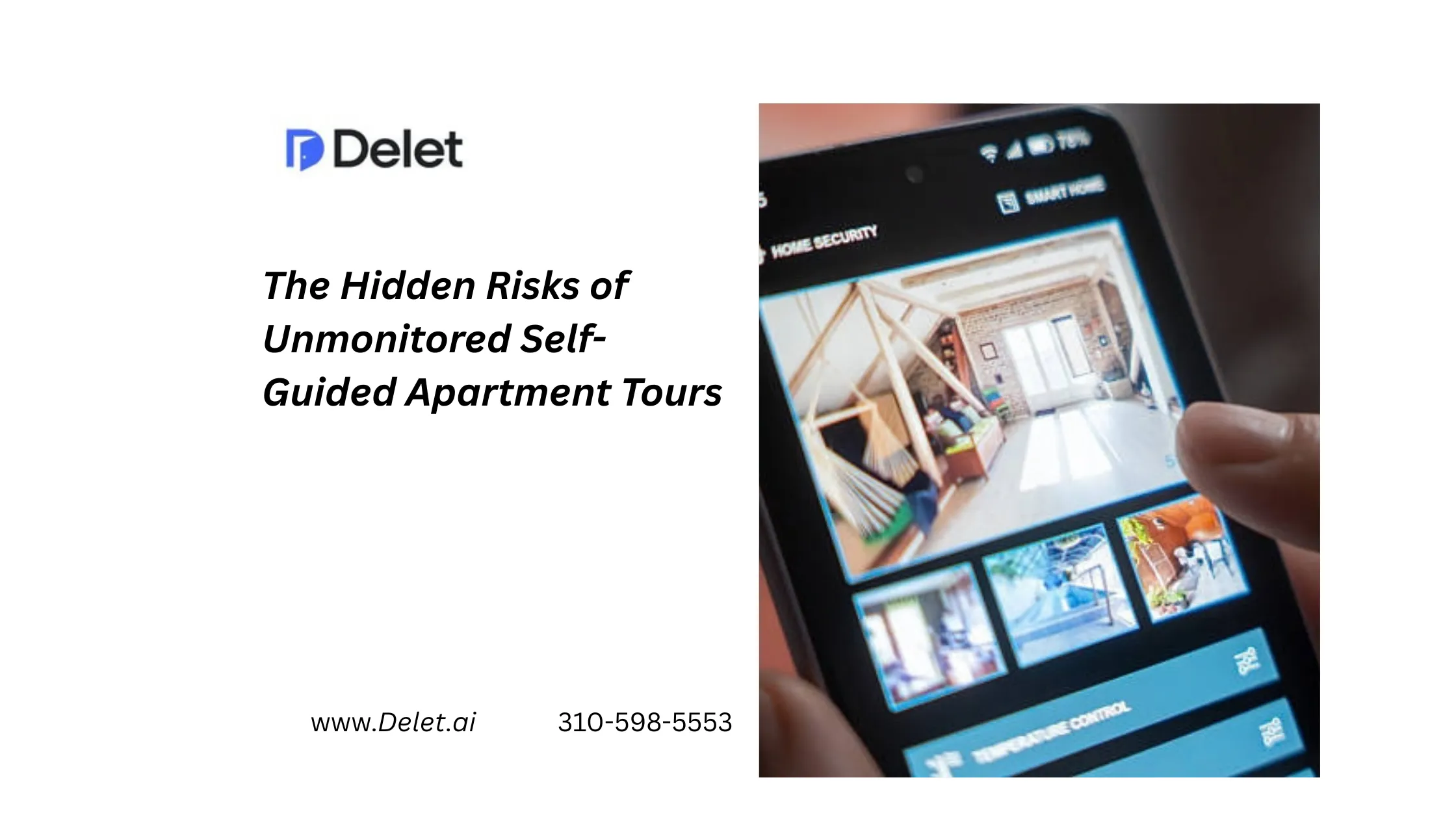
With live HD camera monitoring, authorized property teams can have visibility into tour activity rather than relying entirely on a prospect’s report after the visit.
Delet combines live HD camera streams, remote access control, visitor verification, and a centralized dashboard for apartment self-tours.
4. Smart Locks Without a Complete Security Workflow
Installing a smart lock does not automatically make a self-tour program secure.
The lock is only one component.
A stronger workflow looks like:
Prospect → Identity Verification → Approved Tour → Temporary Access → Tour Monitoring → Access Expiration → Activity Record
This is why smart lock integration should be evaluated together with verification and monitoring rather than as a standalone hardware purchase.
5. Privacy and Resident Concerns
Self-guided tours may occur in communities where other residents are present.
Property managers need clear rules around:
- Which areas prospects can enter
- When tours can occur
- How visitors are identified
- Where cameras are positioned
- How recorded information is handled
- How tour instructions communicate resident-sensitive areas
The National Apartment Association recommends creating parameters around self-guided tours to address safety and privacy concerns.
6. Poor Incident Visibility
Imagine a property manager receives a complaint that something happened during a tour.
Without centralized records, the manager may need to reconstruct the event from texts, emails, lockbox records, and staff notes.
A centralized property dashboard can make this process easier by connecting tour schedules, access activity, and related prospect information in one place.
7. Self-Tours Can Create Operational Work Instead of Removing It
A poorly designed self-tour process can simply move the workload somewhere else.
Instead of manually showing apartments, staff may end up manually:
- Verifying prospects
- Issuing codes
- Checking access
- Answering tour questions
- Monitoring activity
- Following up afterward
- Updating records
That defeats much of the operational benefit.
ShowMojo’s current materials, for example, emphasize automated verification, access controls, fraud protection, and automated follow-up as part of the broader self-showing workflow.
What a Secure Apartment Self Tour Should Include
| Security Layer | What It Protects Against | What Property Managers Should Look For |
| Visitor identity verification | Fake or unauthorized visitors | Verification before access |
| Smart lock integration | Physical key sharing | Unique, temporary credentials |
| Access expiration | Reused credentials | Automatic expiration |
| Access history | Unknown entry | Time-stamped audit trail |
| Live HD camera monitoring | No visibility during tours | Real-time authorized viewing |
| Centralized property dashboard | Disconnected records | Tours, access and activity in one place |
| Clear tour boundaries | Resident/privacy concerns | Defined areas and instructions |
| Automated follow-up | Missed leasing opportunities | Post-tour communication |
Similarly emphasizes ID verification, smart-lock integration, visitor tracking, and real-time data for risk management.
How Self-Guided Tours Can Reduce the Cost of Vacancy
Security and leasing efficiency should be evaluated together.
For example, an apartment renting for $2,400 per month has an approximate daily rental value of:
$2,400 ÷ 30 = $80
If operational delays contribute to an additional 15 vacant days:
$80 × 15 = $1,200
This is only an illustrative lost-rent calculation, not a guarantee of savings.
Property managers can use Delet’s Apartment Vacancy Cost Calculator to estimate the potential financial impact of vacant units.
A well-designed apartment self tour can help reduce some workload around scheduling and access, while giving qualified prospects more flexibility to view available units.
Related blog: TDI Properties Success Story: How Apartment Self Tours Reduced Vacancy Days by 40%
How Self-Guided Tours Reduce the Workload
The operational advantage comes from removing repetitive coordination.
Instead of:
Lead → Phone call → Staff availability → Schedule → Key coordination → Showing
a technology-supported process can become:
Lead → Verification → Schedule → Temporary Access → Self-Tour → Follow-Up
Delet describes its platform as combining smart locks, visitor identity verification, secure apartment self-tours, real-time monitoring, centralized dashboards, and automated leasing workflows.
That combination matters for property managers overseeing multiple buildings because the workflow can be managed centrally rather than requiring physical presence at every unit.
Common Mistakes Property Managers Should Avoid
Mistake 1: Treating a smart lock as the entire security solution.
Access control needs verification, expiration, and auditability.
Mistake 2: Giving prospects reusable codes.
Credentials should be temporary and tied to an authorized tour.
Mistake 3: Ignoring listing fraud.
The FTC’s warnings show that legitimate self-tour infrastructure can be misused by scammers.
Mistake 4: Installing cameras without a clear privacy policy.
Camera placement, access, retention, and resident privacy should be addressed before deployment.
Mistake 5: Measuring only tour volume.
Property managers should also monitor completed tours, applications, conversion, access incidents, and time-to-lease.
How to Evaluate Self-Tour Software
Before selecting a platform, ask:
- Is identity verified before access?
- Does every tour receive unique temporary access?
- Does access automatically expire?
- Can managers see access history?
- Is live monitoring available?
- Is camera monitoring included or a separate add-on?
- Is there one centralized dashboard?
- Can the system scale across multiple properties?
- Does it support existing buildings without major rewiring?
- Can the platform connect tour activity with leasing workflows?
These questions help property managers evaluate the whole operating system, rather than simply comparing smart locks.
Conclusion
Self-guided apartment tours are not inherently risky. Unmanaged self-guided tours are.
The strongest programs combine visitor identity verification, smart lock integration, temporary access, access history, live HD camera monitoring, and centralized property management tools.
For U.S. multifamily operators, the objective is not to choose between convenience and security. The better approach is to design the apartment self-tour experience so convenience for qualified prospects is supported by appropriate controls for the property and its residents.
FAQs
Are self-guided apartment tours safe?
They can be when supported by identity verification, controlled access, temporary credentials, audit trails, clear tour boundaries, and appropriate monitoring. The National Apartment Association recommends safeguards for unaccompanied tours.
What is visitor identity verification?
It is a process used to confirm that the person requesting property access matches the identity information required by the property’s touring workflow.
Why are smart locks important for self-guided tours?
Smart locks can provide temporary, remotely managed access without relying on physical keys or permanent lockbox codes.
Can self-guided tours increase rental fraud risk?
Self-tour infrastructure can be misused by scammers. The FTC has specifically warned about scammers copying legitimate rental listings and using self-guided-tour mechanisms to appear legitimate.
What is real-time tour monitoring?
Real-time tour monitoring allows authorized property personnel to view live activity through connected cameras during a showing, where legally and operationally appropriate.
September 23, 2026